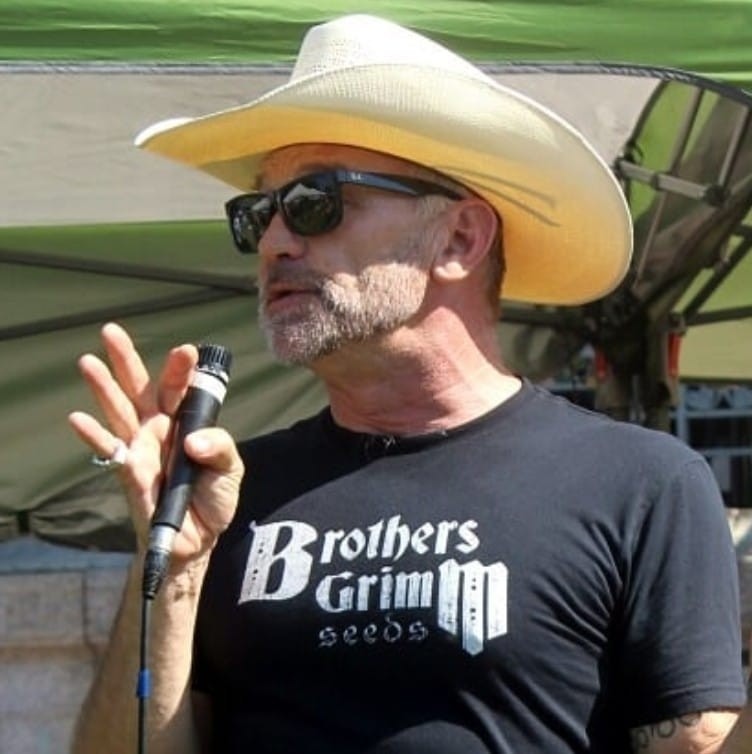
Boston Freedom Rally: September 21, 2019
In the world of powerful ideas, of movements, human inquiry is the key factor. The United States is a nation founded on the freedom to think outside the box. I’m Mr. Soul, founder of Brothers Grimm Seeds, and my name is Rick Campanella. My life has been a life of Socratic inquiry. It began as a youth, wandering the forests of upstate New York, studying pond life and plant life, simply wondering from a very early age about our survival in a world before technological advances. I was a curious kid. And my curiosity stayed with me through the teenage years of expanding perceptions, the college years of focused inquiry, and into my adult life where I worked as a nuclear engineer educated at a top university through graduate school. I was able to balance my life between the world of engineering, thinking inside certain parameters, and starting my inquiry into cultivating a strain that would produce the kind of uplifting feeling that would widen my and others’ perception. In my lifetime, this has been serious outside the box thinking. One might say we in the “business” are as curious as the folks who traveled across the Atlantic to find the freedom to think for ourselves.
Through reading a certain magazine in college, I found books about growing which immediately connected with my childhood curiosity and immediately corresponded with my education in the scientific methods in which I’d been trained. Bringing that deeper sense of connection together was my desire to find out more, to inquire about best practices, and I received a great apprenticeship opportunity through the Super Sativa Seed Club based in Holland. I became their U.S. distributor and began work on developing my own strains which resulted in Cinderella 99, one many connoisseurs would say is one of the best uplifting feelings they have experienced. However, I was growing my own, and it was illegal. I had to hide in the shadows of Nancy Reagan’s War. It was now not only a hippie counter-culture but had gained a dangerous “cre in the park” grossly violent reputation.
We’re celebrating 30 years of assembling here to call out for the legalization of it, and we have finally succeeded. Here. But our job is not complete. I, as a grower, want to shine a light on science and reasonable thought. We still have work to do to dispel the old wives tales, voodoo and witchcraft sensibility. We want to benefit our whole community by sharing the information that guides people in following processes to go about this business of growing the right way.
To quote Dr. Martin Luther King’s brilliant and effective tension-filled “Letter from a Birmingham Jail,” when we are told to wait, to wait while our brothers and sisters are arrested and incarcerated, to wait while alcohol and prescription cures are touted as effective and acceptable intoxicants, to wait for further study of the impacts of the herb, a natural substance used by human beings for thousands of years, we must ask how this wait enlightens anyone? We must raise our voices. We must enquire as to why with the gains made, we still must remain shrouded in a sense of criminality. God forbid we legalize it in case it’s not safe while every 15 minutes, we hear advertising telling us the FDA has approved a cure that carries with it a long list of clearly dangerous matters.
I know I’m preaching to the choir here, but we are definitely here to “come out” in much the same way other sidelined groups have pushed out from the shadows to gain the freedom to live in the light. We, the people, must come into full flower alongside our plants. Why are we considered to be engaged in illegal activities when cultivating and using a natural substance that has for thousands of years been used by human beings as a healing, relaxing, mind-expanding herbal remedy? How have we come to a place in our civilized culture where pharmaceutical companies can directly market cures to every adult and child on the planet while including a compulsive and lengthy list of contraindications that can possibly kill the host body?
We have been cowed by the forces of political oppression. We have learned to live in the corner with some doubt as to our validity in a culture that raised us to believe in our persona as outcasts. Personally, I resisted approaching women I was attracted to for fear of them rejecting me as a “stoner.” And, that’s a double-edged sword in that many of us do enjoy the hip and cool sense of being counter-culture while those of us here today are ready to join the mainstream and be accepted as independent business people and herb connoisseurs. Look at alcohol sales and you will see the future of it. There’s a market that was once prohibited. Now, we know and accept as run-of-the-mill the huge population that comes home every evening to their favorite libation, and it’s celebrated by the entire culture. Alcoholic beverages are as popular as soft drinks. Hell, many liquors are now marketed for their “soft drink” taste.
Based mostly on propaganda and misinformation, the herb was vilified in the 1930s as an illegal intoxicant that caused violent crime. We have good reason to make a connection between the lift of prohibition in 1933 and the Congressional “Marihuana Tax Act” of 1937. […The exigencies of the fiscal crisis forced many commonwealths to turn to the beverage industry for help. Between 1933 and 1935, 15 states adopted monopoly systems; these states were broke and in order to stock their chains of stores had to buy on credit from the distillers.] Could this be seen as a capitalist marketing scheme, giving leeway to alcohol consumption as the accepted form of relief from a stressful day? Alcohol has never cured illness. It creates and exacerbates illness. Alcohol is responsible for death due to illness and, far more often, death due to violence. When inebriated, classic images show “tough guys” in drunken bar fights. Domestic violence rises under the influence of alcohol. Groups become mobs. Sporting events become danger zones with cars lit on fire in parking lots after a losing game where hours earlier these same folks had convivial tailgate parties.
Despite 60 years of criminal prohibition, the herb remains the third most popular recreational intoxicant. And let’s not leave out the racist leanings of this criminalization. The Marijuana Act was directed at immigrants which carried over to high-profile politicians labeling Black teens as “super predators.” Blacks and Hispanics represent 20% of our population yet represent 58% of the herb offenders sentenced under federal law. [This “dreadful example” is now so firmly established that it has become a maxim of popular culture, a paradigm of bad social policy, and a ritual invocation of opponents of a variety of sumptuary laws. The record of the 18th Amendment often has been read by libertarians as a morality tale. Detached and abstracted from their historically specific contexts and presented as a single crusade around which cranks and fanatics have clustered for 150 years, temperance and prohibition have been portrayed as touchstones of bigotry. The lineage of reaction is traced straight from sin-obsessed Puritans, to evangelical extremists and Know-Nothings, to nativists and Klansmen, and most recently to McCarthyites and antiabortionists.] Imagine at this moment if the higher proportion of those arrested belonged to a newly protected group such as those who have joined forces in the LGBTQ community. Millions of Americans have been arrested since the Commission Abuse recommended decriminalization in the 1970s. We are in the midst of an opioid crisis where vast groups of our citizens are addicted to and suffering from a cure that was legally prescribed as a cure to what ails them. In reality, the majority of those people would have done well, using it to alleviate their pain, anxiety, and seizure disorders. Criminalization which includes arrest and incarceration has cost our nation tremendously. We, you and I, pay for the resources used to keep millions imprisoned; millions who must live as criminals in and out of the prison system due to their dealing in the third most used recreational intoxicant in our nation? According to the Center for American Progress, our economy would save “$7.7 billion dollars per year in averted enforcement costs and would yield an additional $6 billion in tax revenue” by legalizing it.
I now live not in the criminalized environment of New York state but in the forward-thinking state of Colorado. And I am speaking to you today in the great state of Massachusetts, a state begun by those who struggled with hive-mind thinking over centuries and has produced some of our greatest independent-minded thinkers. This move to Colorado has been an amazing shift in my psyche as well as my cultivation practices. Sharing the knowledge that is constantly evolving in my experience after coming out of the shadows and reopening a business that began with Cinderella 99 and has progressed to produce, most recently, the Rosetta Stone strain which is critically acclaimed for its strength, taste, and yield. Decriminalization carries with it the tenet that we share our experiences to bolster the entire community.
In a recent book review about ___, Albert Goldman (1979, p. 250) wrote:
The only controls should be those that are imposed to protect the public from bogus or polluted merchandise. With the dreadful example of Prohibition before us, it seems nearly unthinkable that we should have done it again: taken some basic human craving and perverted it into a vast system of organized crime and social corruption. When will we learn that in a democracy it is for the people to tell the government, not for the government to tell the people, what makes them happy?
…Alcohol was also believed to be conducive to social as well as personal health. It played an essential part in rituals of conviviality and collective activity; barn raisings, huskings, and the mustering of the militia were all occasions that helped associate drink with trust and reciprocity. Hired farm workers were supplied with spirits as part of their pay and generally drank with their employer. Stores left a barrel of whiskey or rum outside the door from which customers could take a dip.
…Drunkenness was condemned and punished, but only as an abuse of a God-given gift. Drink itself was not looked upon as culpable, any more than food deserved blame for the sin of gluttony. Excess was personal indiscretion.