The DEA recently announced that seeds officially meet the requirements to be designated fiber as interpreted by federal law. The principal requirement to earn the designation being that seeds contain less than 0.3% chemically – which, in all cases is true. Regardless of the seed’s potential to grow into a chemical producing plant, the seed itself is fiber by definition. There is no legal difference between seeds that grow into plants and seeds that grow into chemical producing (let’s just say “the herb”) plants at the federal level.
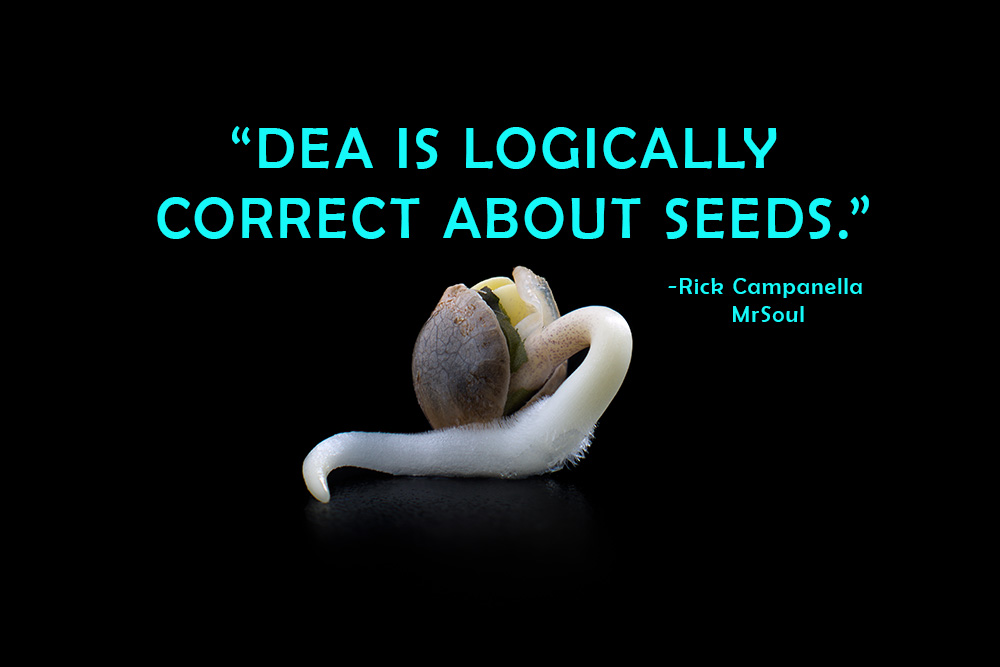
At a state level, seeds which produce them are too often controlled as if they were in the beginning. However, we can’t define an entity by what it might be in the future… that would be equivalent to considering all eggs to be chickens. The DEA’s interpretation is the logically correct one.
Sadly, state laws controlling seeds as if they were are blatantly ignoring the federal legal definition of fiber to their own detriment, which is illogical for several reasons. By prohibiting the import and export of seeds, they create a roadblock for new genetics that benefit the farmers and patients of their state. New genetics that may aid disease or introduce remarkable new qualities should be utilized as soon they are discovered. And from the standpoint of one asking “what benefit was intended by the creation of the law?” it truly begs the question “who benefits when the distribution of seeds is restricted?” There doesn’t seem to be an answer when we search for the utility which should underpin any law – it needs to serve a purpose, otherwise why have a law?
It’s my hope that each state which currently defines seeds will see their error and adopt the federal government’s definition. It will not only increase benefits to the people of the state, it will also streamline and reduce costs of what is arguably an expensive and complicated system.
Rick Campanella,
Founder of Brothers Grimm Seeds